Candomble beleives and culture, originated from african voduns and musically based on drums, are widespread in Brazil, but also traveled south down to Uruguay, where exist also expressions of this religion.
This one is for ears looking for free expriments. From his 1959 "Free Jazz" LP, which open great perspectives in US jazz during the 60s, Ornette Coleman did not stop to innovate. As many free jazz musicians, looking for african roots could take part in the approach. So Dancing In Your Head LP includes an interesting experiment with musicians from Morocco, the Master Musicians of Joujouka, recorded between 1973 and 1975. Being a sufi brotherhood, music from Joujouka aims to reach a trance (a kind of mystic musico-therapy also present in Gnaoua culture) and naturally allows jazzy experiments. And I guess it's not just by chance that the cover artwork represents 2 faces of the same head.
A special post to discover various instruments and rhythms from the afroperuvian musical environment. Afro culture in Peru is direct consequence to slavery of various african ethnic groups brought until 1850. A kind of "identidad costena" (coastal identity) has been developed by the black people and afrodescendientes on the pacific coast, culturally totally different from interior's andean mountains (in some aspects, this regional specificity that can remind La Cuesta in Colombia).
This is a guitar recital, composed and played by Cameroon's multi-artist Francis Bebey. As always with Bebey, it's poetic, sharp and meaningful... (have a look at the enlightening liner notes in french/english).
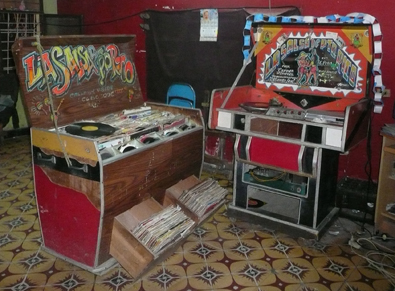
A very interesting cultural aspect on the colombian caribbean coast, particularly in Cartagena and Baranquilla is the Pico Culture. A Pico is a soundsystem that usually plays vinyls (very loud!) during weekends. It developed on the coast from the 60s and evolved up to now with different influences during each decade. The caribbean coast has always been for Colombia the "front door" for other countries, so Baranquilla as principal harbor, received influences (and records) from all around the caribbean and also from Africa. As result, big proportion of the music played is african vinyls from Nigeria, Ghana, Kenya, Zaire, Angola (some DJs play 100% african music). But the selection can also be very diverse (cumbia, gaita, guaguanco, pachanga, tumbele, calypso, reggae... ), demonstrating importance of this crossroad within black atlantic interconnections. In parallel, it also developed a local style played on the soundsystems, initially called "Terapia" then "Champeta". Althoug corresponding more to a "80s sound" (including effects and new technical possibilities), it reveals amazing soukous influences which contributed to a kind of renewing of the african consciousness in popular areas of Cartagena and Baranquilla.
I do not pretend to describe here it all, as its richness makes it an infinite task, but I'll just try to enlighten some aspects discovered during researches in Baranquilla.
Lets begin with a Pico from the 70s, La Salsa de Puerto Rico, from barrio El Bosque.
A kind of "Black Atlantic" musical mixture is here well represented with this album from Bonga (Angola), Tiao Tocha Perazzo (Brazil) and Jo Maka (Guinea). Slaves from Benin, Angola and Congo were transplanted in brasilian Nordeste. From these african roots, afro-brazilian generations developed both sacred music (candomble) and popular music (samba). This beautiful album is a nice way to meet up again musically.
Luis Agudo (1940-) is an Argentinian percussionist who developed an unique style based on brazilian and african drums and rhythms. He's a real rhythmic explorer, building his own percussions. This led him to play worldwide for many jazz musicians (Baden Powell, Dizzy Gillespie, Elvin Jones, Junior Cook...).
This record is a solo recording realized in Italia (original press from Red Records) where he shows his wide variety of sounds, rhythms and effects.
Laba Sosseh (1943-2007) had a 40 years long african salsero carreer, singing pachanga, bolero, guajira, son cubano... He's originally from Gambia, and played during the 60s at Club Miami (Dakar, with Star Band & Ibra Kasse), at Club Sangomar (Thies, with engineer Moussa Diallo). He founded with nigerian sax player Dexter Johnson the Super Star Orchestra de Dakar and recorded for N'Dardisc (Label from Louis Fourment, Radio Africaine director).
One of his hits from this period is the love song "Seyni" (kay fonema sama khol).
Muzzicaltrips will present many exemples of mutual influences between Africa and Latin America.
Here's "Shacalao", played by Colombian Lisandro Mesa, cumbia master, known as "Accordion World Champion", joined by his conjunto.
It consists of a roots afro-colombian version of nigerian king of afrobeat Fela Kuti song "Skakara".
Amazing mixed influences version, atlantic ocean seems to have evaporated...
Lisandro Meza - Shakalao:
Accordeon is so spread in Colombia that I remember talking a guy who could not imagine nor concieve that this instrument was brought from abroad... As I could not convince him, let's have Lisandro Meza's clarification on story of 1st Accordeon in Colombia (A. Wolfe - 2003):
"The first accordion arrived in Colombia via Coveñas, brought by a man named Pisarro, Joaquín Pisarro. He came from Germany and arrived at the ports carrying grappa, wire, hammers, hachets, and machetes, and he traded thesae things for tabacco as he traveled. Once he brought an accordion and he sold it to the Villa Milian Oveja family for two bales of tobacco. The three brothers in the family all learned to play on that accordion.
Later they sold the accordion to Francisco El Hombre, whose real name was Francisco Moscote. They gave him the name "Francisco El Hombre" because he lived in Machovallo, and most of the men from that region were away working in the banana plantations when a plague came and killed many of the children. But there were no men to bury the children. Francisco said, "I am the man who will bury the children", so they called him "Francisco El Hombre" (Francisco the Man). The legend is that he was the first great accordionist from Colombia."




 Luis Agudo (1940-) is an Argentinian percussionist who developed an unique style based on brazilian and african drums and rhythms. He's a real rhythmic explorer, building his own percussions. This led him to play worldwide for many jazz musicians (Baden Powell, Dizzy Gillespie, Elvin Jones, Junior Cook...).


 .
. .
. .
.


