Showing posts with label soundsystem. Show all posts

Pico Culture #04 - Soundsystem aesthetics (Baranquilla)

Above painted wood piece is an original decoration from the pico "El Solista", carefully conserved by a fanatical pico lover.
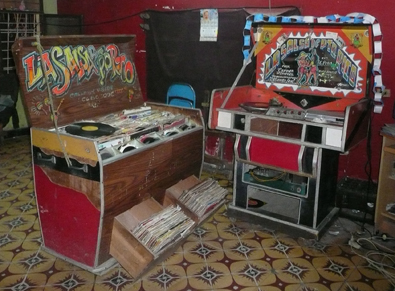
From the 70s each pico developed his own aesthetics through colorful paintings and decorations on the speakers and the control tower. This transmits a real identity to each pico, and can be inspired from pure psychedelic figures (El Dragon, El Cobra), or from personal experiences (for example, El Coreano was created by a colombian man who went to fight in Korea war), or from musical artists (El Pijuan), or from revolutionary figures (El Gran Che, El Gran Fidel). The visual identity personifies the pico, and usually transmits a message of power ("indestructible", "la potencia africana", "guerrillero de la salsa").
It really contributes to glorify the soundsystem, as being also considered as a piece of art.

Pico Culture #03 - Mysterious records

In order to maintain exclusivity of tracks played on each pico (and thus gain loyalty of the public who has to go to the party to listen to specific exclusive hits), it was common to tear away or paint the label sothat no one could read the original track. The result is some really unique beautiful pieces, but also some unidentified hits (everyone knows the song but no one knows who was the artist, so the track is only known by his spanish surname). That's the case with the following 7" played by the pico El Dragon, but originally from the famous pico El Coreano.

Pico Culture #02 - MIX /// Terapia Africana Mix (a selection of pico african hits)

From the 70s, while the soundsystem culture was developing, more and more african records arrived on the colombian coast due to increasing commercial exchanges between international harbors.
Some african songs became hits, african styles being surnamed: nova for highlife tracks, rastrillo for kenyan tracks... It was such a big success for the youth of Cartagena and Baranquilla that even each popular song received his own surname. Also several tracks have been bootlegged in terapia/champeta  compilations (which leads to find improbable records including a pure benga followed by an awful 80s techno), and not always credited the original artist/title, but just the local surname known by everybody.
That's the reason of this special selection, composed only of african tracks (Liberia, Angola, Kenya, Nigeria, Ghana, Ivory Coast, Zaire). These tunes are popular in Baranquilla's southern barrios, as long as you speak about: la botellita, el serrucho, la guitarrita, la mecedora, la munequita, el rastrillo, el beto, los palitos, la pipona,  el ejen, el akien, la llorona...

Pico Culture #01 - Introducing "El Pico"


A very interesting cultural aspect on the colombian caribbean coast, particularly in Cartagena and Baranquilla  is the Pico Culture. A Pico is a soundsystem that usually plays vinyls (very loud!) during weekends. It developed on the coast from the 60s and evolved up to now with different influences during each decade. The caribbean coast has always been for Colombia the "front door" for other countries, so Baranquilla as principal harbor, received influences (and records) from all around the caribbean and also from Africa. As result, big proportion of the music played is african vinyls from Nigeria, Ghana, Kenya, Zaire, Angola (some DJs play 100% african music). But the selection can also be very diverse (cumbia, gaita, guaguanco, pachanga, tumbele, calypso, reggae... ), demonstrating importance of this crossroad within black atlantic interconnections. In parallel, it also developed a local style played on the soundsystems, initially called "Terapia" then "Champeta". Althoug corresponding more to a "80s sound" (including effects and new technical possibilities), it reveals amazing soukous influences which contributed to a kind of renewing of the african consciousness in popular areas of Cartagena and Baranquilla.
I do not pretend to describe here it all, as its richness makes it an infinite task, but I'll just try to enlighten some aspects discovered during researches in Baranquilla. 

Lets begin with a Pico from the 70s, La Salsa de Puerto Rico, from barrio El Bosque.