Flute and tenor sax player Yusef Lateef (1920-2013) just passed away, so here's a post dedicated to this real sound explorer (before being a jazzman), who integrated eastern or african influences in many of his recordings. Famous for his deep, free and spiritual music all along the 60's and 70's in the US, he also directly enriched his open-minded approach spending years in Nigeria in the early 80's.
If you follow muzzicaltrips you probably know already the Poly Rythmo funky bomb "Ne te Fache Pas". But could you imagine to find it covered by a jazz-blues american musician? I could not, so it was a real surprise when I discovered this cover version.
Here's a unique musical project auto produced by Dane Belany and release in New York by Sahara label. Influences are clear: dedicated to Frantz Fanon, and lyrics from several songs inspired by Aimée Cesaire or David Diop (senegalese pan-africanist poet from the 50s).
Entering Randy Weston spiritual world is a long story. Let's just have a glimpse at his special relation with the city of Tangier (Tanjah is local name).
At 72 years old, Roy Ayers is still playing his vibraphon live. Listening to the disco oriented track "Evolution" he played last weekend, reminded me of this 7", from the album "Mystic Voyage".
This one is for ears looking for free expriments. From his 1959 "Free Jazz" LP, which open great perspectives in US jazz during the 60s, Ornette Coleman did not stop to innovate. As many free jazz musicians, looking for african roots could take part in the approach. So Dancing In Your Head LP includes an interesting experiment with musicians from Morocco, the Master Musicians of Joujouka, recorded between 1973 and 1975. Being a sufi brotherhood, music from Joujouka aims to reach a trance (a kind of mystic musico-therapy also present in Gnaoua culture) and naturally allows jazzy experiments. And I guess it's not just by chance that the cover artwork represents 2 faces of the same head.
When the famous american composer Charles Fox plays "Just For Fun", it results a nice and sharp latin album from 1963, influenced both by classical and jazz elements.
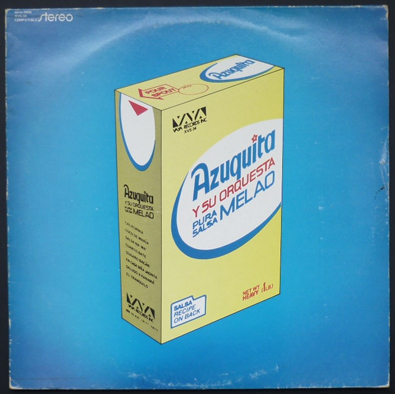
Vaya records is a NY based label created in 1971 as sub-label from Fania records, with a focus on latin artists and productions with soul funk and jazz orientations. Here's a good illustration with an Azuquita track full of various influences: superfunky guitar, roots afrocuban voices and drums, and guaguanco rhythm (original song was composed by Saoco).
All is resumed in the singer's introduction: "This is the story of a guajiro, who went out the jungle searching out new horizons"
The introduction of cora and djembe in an american disco-funk production is not always easy to achieve coherently, but here the blend of influences works pretty well, with strong african influence, thanks to top class musicians involved:
Gil Scott-Heron just died 2 days ago. In order to remember this major RAP (Rhythm And Poetry) figure, I just selected 5 tracks from my favorite albums: "Peace Go With You, Brother" for a spiritual funeral, "Who'll Pay Reparation On My Soul?" for the afro-american militancy, "Lady Day and John Coltrane" for the soul and jazz inspiration, "The Bottle" for the funky percussive groove.
Winter In America
Strata-East, 1976
Gil Scott-Heron - Peace Go With You, Brother:
Small Talk at 125th and Lennox
Flying Dutchman, 1970
Gil Scott-Heron - Who'll Pay Reparation On My Soul?:
Pieces Of A Man
Flying Dutchman, 1971
Gil Scott-Heron - Lady Day And John Coltrane:
It's Your World (Live Album)
ARISTA, 1976
Gil Scott-Heron and Brian Jackson - The Bottle (Live):
Jazz et Vin de palme (Jazz and Palm wine) is composed by 8 novels from congolese writter Emmanuel Dongala who lived in the US during the 60s.
These differents texts represent opposition between Music as a liberation / politicians as oppression. Influenced by his own experiences, his writings also reflect the meeting of two different worlds (jazz is -supposed to be- from the US, palmwine from Africa). Jazz et Vin de Palme is the first african science-fiction novel, in which people from earth liberate from aliens invasion thanks to John Coltrane's jazz (!)
Here's a spicy version of "Quiere" by Jack Costanzo recorded live at the Garden of Allah (Hollywood). Mr Bongo always deserves his surname, even playing a cha-cha...
Liberia was declared a republic in 1847. This west african country has been created by freed american slaves "coming back" to Africa, which represents a unique (and controversial) experience.
To celebrate the centennial in 1947, the liberian government ordered Duke Ellington to compose a suite for the occasion.
Credits:
Duke Ellington – piano
Shorty Baker, Shelton Hemphill, Al Killian, Francis Williams - trumpet
Ray Nance - trumpet, violin
Lawrence Brown, Tyree Glenn - trombone
Claude Jones - valve trombone
Jimmy Hamilton - clarinet, tenor saxophone
Russell Procope - alto saxophone, clarinet
Johnny Hodges - alto saxophone
Al Sears - tenor saxophone
Harry Carney - baritone saxophone, vocal (track 1)
Fred Guy - guitar
Oscar Pettiford, Junior Raglin - bass
Sonny Greer - drums
This suite has been perfomed live twice in Carnegie Hall, never in Liberia.
Duke Ellington had a trip to Africa 20 years later, during Senghor's official Festival des Arts Negres in Senegal (1966).
From the 60s avant garde jazz to the 70s jazz rock fusion, Michael White had opportunity to play his violin with many kind of musicians. He released 3 LPs on Capitol with his band The Fourth Way, then various albums as leader on Impulse, and worked as sideman for Pharoah Sanders or Alice Coltrane.
The Land of Spirit and Light is a creative melodic and percussive mixture, allowing space for improvisations supported by Cecil McBee punchy bassline. This track is a unique trip around Fela Kuti's "Egbe Mi O"... Michael White seems to suggest that Spirit and Light are to be found (or at least searched) in Africa.
Michael White - The Land of Sipirt and Light (Part 3):
Michael White (violin)
Kenny Jenkins (vocals)
Bobby King (guitar, classical guitar)
Bob King (classical guitar)
Cecil McBee (bass instrument)
Stanley Nash (vocals)
Prince Lasha (flute, alto flute, piccolo, clarinet)
Ed Kelly (piano)
Kenneth Nash (percussion)
Ever heard a Fela Kuti track played by capeverdean artist based in Holland?! Check HERE.
A small post dedicated to Keith Elam (Guru), died by 19/04/2010. West coast rap singer, he founded GangStarr in 1989 with DJ Premier.
The 1st Jazzmatazz project, presented in 1993 as "an experimental fusion of hip hop and jazz", is a musical gem (including prestigious featurings as Roy Ayers, Donald Byrd, Lonnie Liston Smith), and open the way to deeper collaboration between rappers and jazzmen. Always good to remind that hip hop comes from jazz...
Chrisalys F1-21998
Guru - Jazzmatazz vol.1 - Introduction
Guru previoulsy rapped "Jazz Thing" (used in Spike Lee's Mo Better Blues), where the message about importance of jazz was more than clearly expressed: